Coursera Stable Diffusion Flux Ideogram Grok Adobe Firefly

Building with the Claude API

By Stephen Adler Posted: Jul 30, 2026

Course Details

Pricing Freemium
Offered By Anthropic
Difficulty Beginner
Duration 1 Week (Approximately 13 Hours)
Language English
Certificate Available

Course Curriculum & Description

Discover how to develop production-ready AI applications using the Anthropic Claude API. This hands-on course teaches developers how to integrate Claude into software applications, automate complex workflows, and build intelligent AI systems using modern development techniques.

You'll explore prompt engineering, Claude tool use, Model Context Protocol (MCP), Retrieval-Augmented Generation (RAG), agentic workflows, and API integration while learning best practices for developing scalable AI-powered applications.

Whether you're a software developer, AI engineer, product builder, or entrepreneur, this course provides practical experience in building reliable applications with Claude and Anthropic's AI ecosystem.


Course Modules

Module 1 — Getting Started with Claude

  1. Claude Fundamentals
  2. Claude API Overview
  3. Development Environment

Module 2 — Prompt Engineering & Evaluation

  1. Prompt Design
  2. Prompt Optimization
  3. Response Evaluation

Module 3 — Claude Features & Tool Use

  1. Claude Tool Calling
  2. Function Integration
  3. External Services

Module 4 — Model Context Protocol (MCP)

  1. MCP Fundamentals
  2. Context Management
  3. AI Communication

Module 5 — Retrieval-Augmented Generation (RAG)

  1. Knowledge Retrieval
  2. Document Search
  3. AI Context Enhancement

Module 6 — Claude Code & Computer Use

  1. Claude Code
  2. Coding Workflows
  3. Developer Tools

Module 7 — Agentic Workflows

  1. AI Agents
  2. Multi-Step Automation
  3. Intelligent Task Execution


What You Will Learn

  • Integrate Claude API into applications
  • Design advanced AI prompts
  • Implement agentic workflows
  • Build scalable AI assistants
  • Use Claude tools effectively
  • Develop RAG applications
  • Understand MCP architecture
  • Automate complex AI tasks
  • Improve AI application reliability
  • Deploy Claude-powered software

Course Prerequisites

Basic programming knowledge
Familiarity with APIs
Understanding of software development concepts
Internet connection
Interest in Generative AI

Course Highlights

Official Anthropic Course
Claude API Integration
Prompt Engineering
Agentic AI Workflows
Model Context Protocol (MCP)
Retrieval-Augmented Generation (RAG)
Real-World Projects
Beginner Friendly
Hands-on Coding Exercises
Shareable Certificate


Tagged Topics & Skills

Categories:
Skills Mapped:
Python Prompt Engineering Claude API RAG AI Agents Generative AI Claude AI AI Development Anthropic Model Context Protocol MCP Retrieval-Augmented Generation Claude Code API Integration LLM Applications Agentic Workflows Software Engineering

Ready to Start Learning?

Enroll directly on the official Coursera website to begin your lessons.

Open Course Website

Associated AI Tools

CinLink

CinLink AI is an AI-powered media workspace that helps users create, edit, translate, dub, subtitle, summarize, and repurpose videos using natural-language instructions. It coordinates different AI models and media tools inside one workflow, allowing creators to work with their own footage, images, and files while reviewing results before exporting the final version.Uses of CinLink AICinLink AI can turn long videos into short clips, generate subtitles and SRT files, transcribe speech, translate videos, create multilingual captions, add voiceovers, and burn subtitles directly into videos. It can also search through media for specific people, spoken words, scenes, actions, or on-screen text, making large video projects easier to manage.The platform also supports creative workflows such as text-to-video, image-to-video, reference-based generation, image creation, video editing, aspect-ratio changes, video enhancement, watermarks, summaries, and social-media versions. Users can create multiple versions of the same project, including 16:9, 9:16, and 1:1 formats, without rebuilding the entire workflow.CinLink AI Models & Sub-ModelsAI Media Workflow Engine coordinates the different AI models and media-processing tools needed to complete a user's request. Instead of requiring users to select every individual tool, CinLink can understand an instruction and build a complete workflow from processing to final export.AI Video Generation supports text-to-video, image-to-video, reference-based generation, and creating missing shots. This helps users generate new visual content or add scenes to an existing project.AI Image Generation can create images from text, produce image variations, work with reference images, and generate covers, thumbnails, and storyboard frames for video projects.AI Transcription & Subtitle Generator converts spoken audio into timed subtitles. Users can review and edit the generated text, adjust timing, style captions, export SRT files, or permanently burn subtitles into videos.AI Translation & Dubbing can translate captions and video content into other languages and prepare multilingual voice tracks. Users can review translations, correct terminology, and create bilingual or localized versions of their videos.AI Media Search lets users search across a project using transcripts, visuals, on-screen text, people, speakers, and timecodes. This is useful for finding specific moments in long recordings without manually watching the entire video.AI Video Repurposing can turn an approved video into short highlights, social-media clips, different aspect ratios, captioned versions, language versions, and summaries. This makes CinLink useful for producing multiple pieces of content from one original video.PricingCinLink uses a credit-based pricing model. Its current Free plan provides 100 one-time credits, while the Creator plan costs $19/month with 2,500 credits and the Studio plan costs $59/month with 8,500 credits. An Enterprise option with custom pricing is also available.Free: Yes, 100 one-time creditsPaid: Yes, Creator and Studio plansFree Trial: Yes, through the Free planBest Use CasesCinLink AI is best suited for content creators, video editors, social media managers, marketers, podcasters, educators, freelancers, small businesses, and creative teams. It can be used to create social-media clips, subtitle videos, translate content, produce multilingual versions, dub videos, summarize webinars, find important moments in long recordings, create product videos, and repurpose existing footage. Its natural-language workflow is especially useful for people who want to describe what they need instead of manually managing every editing step.
Free

TubeRepeat

TubeRepeat is a free YouTube practice and repetition tool that helps users loop any part of a YouTube video with precise A-B controls. Users can select an exact section, slow it down, repeat it continuously, and track repetitions. It is especially useful for musicians, language learners, dancers, students, and anyone who learns by watching and repeating videos.Uses of TubeRepeatTubeRepeat allows users to select a specific section of a YouTube video and play it repeatedly without manually scrubbing back and forth. Users can set start and end points with precise timing, adjust playback speed from 25% to 200%, and repeat the selected section until they are comfortable with it.The platform is designed around deliberate practice. Musicians can repeat difficult riffs or drum patterns, language learners can practice pronunciation and listening, dancers can break down choreography, and students can replay difficult parts of lectures. Users can also automatically increase the playback speed after a set number of repetitions and share saved practice sessions through a link.TubeRepeat Features & Sub-FeaturesA-B Repeat lets users choose an exact start point and end point in a YouTube video. The selected section then plays continuously, making it easier to practice a specific sentence, movement, musical phrase, or lesson.Precision Loop Controls allow users to set loop points with second-level precision. Users can drag timeline handles or enter exact timestamps to isolate the part of the video they want to practice.Variable Playback Speed allows videos to be slowed down to 25% speed or increased up to 200%. Users can also adjust playback speed in small 0.05× steps, which is useful when gradually building confidence and accuracy.Progressive Speed Training automatically increases the playback speed after a chosen number of repetitions. This helps users gradually move from slow practice to normal or faster speeds without constantly changing the controls themselves.Keyboard Controls allow users to set A and B loop points using keyboard shortcuts, including the S and E keys. This is particularly helpful for musicians and other users who want to keep their hands on their instrument or away from the mouse.Rep Tracking counts how many times a selected section has been repeated. This gives learners a simple way to measure their practice sessions and maintain consistency.Save & Share Sessions creates a unique link containing the selected YouTube video, loop points, and playback speed. Users can bookmark the session or share it with a teacher, classmate, coach, or bandmate so the exact practice setup can be restored.Full Video Looping allows users to repeat an entire YouTube video when they do not need to isolate a particular section. Unlike YouTube's standard loop feature, TubeRepeat also provides additional speed and session controls.PricingTubeRepeat is free to use. Users can paste a YouTube URL, select their desired section, and start repeating without creating an account, installing a browser extension, or downloading software. The website currently presents its core repeat and loop features as free.Free: YesPaid: No paid plan currently highlightedFree Trial: Not applicable — the core tool is freeBest Use CasesTubeRepeat is best suited for musicians, singers, language learners, dancers, students, teachers, athletes, and anyone who learns through repetition. It can be used to practice guitar riffs, piano passages, drum patterns, pronunciation, conversations, dance movements, sports techniques, tutorials, and difficult lecture sections. Its combination of precise A-B looping, adjustable playback speed, progressive speed training, repetition tracking, and shareable sessions makes it a simple tool for turning ordinary YouTube videos into structured practice sessions.
Free

Lium AI

Lium AI is an agentic AI platform built for analyzing complex, real-world data. It connects databases, files, APIs, scientific data, and internal tools so AI agents can work across different data types and formats. Lium can write code, build reusable tools, analyze large datasets, and turn complex information into reports, charts, datasets, and other useful outputs.Uses of Lium AILium AI helps teams ask questions about their data using natural language instead of manually building complex data pipelines. It can combine structured databases with documents, spreadsheets, images, sensor data, satellite information, scientific files, and other specialized formats to find relationships and generate useful insights.The platform is particularly useful for industries working with large and complicated datasets. It can support geospatial analysis, energy research, space and aerospace projects, infrastructure, scientific research, competitive intelligence, supply-chain analysis, operational analytics, and other data-heavy workflows. Lium can also automatically provision computing resources when an analysis requires heavy processing.Lium AI Models & Sub-ModelsLium Agentic AI is the core AI system that works with connected data, tools, and computing resources. Instead of simply answering a question, Lium can plan work, write code, use tools, analyze information, and produce a finished result.Lium Connections provides secure access to external data sources such as Amazon S3, Azure, Google Cloud, databases, uploads, and other connected systems. Lium brokers these connections so agents can access information without exposing the underlying credentials.Lium Artifacts turns connected data into a virtualized workspace that AI agents can work with. This allows large and distributed datasets to be used without requiring everything to be moved into a single location.Lium Tools allows AI agents to create and reuse custom tools for specific data-analysis tasks. These tools run in sandboxed environments and can become part of the team's reusable workflow, reducing the need to solve the same problem repeatedly.Lium Compute Plane provides computing power for demanding analysis. When a task requires more processing than a normal computer can provide, Lium can automatically scale computing resources without requiring users to manage servers or clusters.Lium Workspaces keep datasets, tools, analyses, and outputs connected across projects. Useful results can become reusable knowledge and infrastructure, allowing future agents and team members to build on previous work instead of starting from scratch.Multimodal Data Intelligence allows Lium to reason across different types of information, including databases, spreadsheets, time-series records, satellite imagery, audio, video, GIS data, seismic files, genomics data, and other specialized formats. This is one of Lium's main differences from general-purpose AI assistants.PricingLium offers a Free starting option that allows users to try the platform and start an analysis. For business and enterprise customers, pricing is based on the organization's requirements, subscription terms, included tokens, and usage. The platform's terms state that enterprise subscriptions can include a specified number of tokens with additional charges for usage beyond the included amount.Free: Yes, free access to get startedPaid: Yes, business and enterprise plansFree Trial: Yes, users can start with a free analysisBest Use CasesLium AI is best suited for researchers, data scientists, engineers, analysts, enterprises, and teams working with large or complicated proprietary datasets. It can be used for scientific research, geospatial intelligence, satellite and space data, energy analysis, infrastructure monitoring, competitive intelligence, supply-chain analytics, operational research, and complex data engineering. Its ability to connect different data sources, automatically scale computing, build reusable tools, and preserve previous analyses makes it especially valuable for organizations where important decisions depend on large amounts of specialized data.
Free

Related Courses

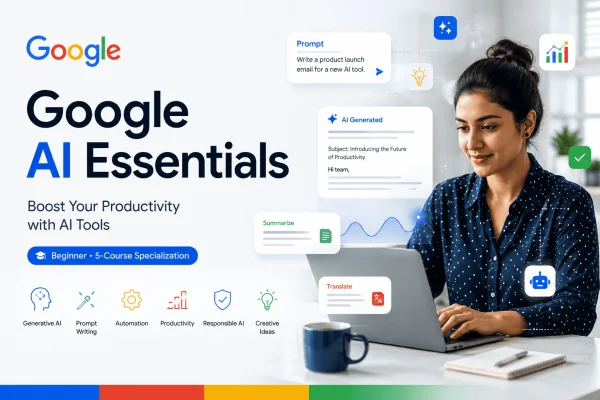
Google AI Essentials Specialization Freemium
Coursera 8 hours

Google AI Essentials Specialization

Learn how to use generative AI tools to improve productivity, develop ideas, write effective prompts, evaluate AI outputs, and use AI responsibly with the Google AI Essentials Specialization.

Google Career Certificates
Beginner 4.8
Advanced Agentic AI and Generative AI Paid
Udemy 2.5 hours on-demand video

Advanced Agentic AI and Generative AI

Learn Generative AI and Agentic AI with Python, covering LLMs, prompt engineering, AI agents, RAG, vector databases, multi-agent systems, tool calling, and real-world AI applications.

Beginner
Google AI Professional Certificate Paid
Coursera 8 hours

Google AI Professional Certificate

Build practical AI fluency with Google’s 8-course Professional Certificate, covering generative AI, prompting, research, communication, content creation, data analysis, and AI-powered app building.

Google Career Certificates
Beginner 4.8