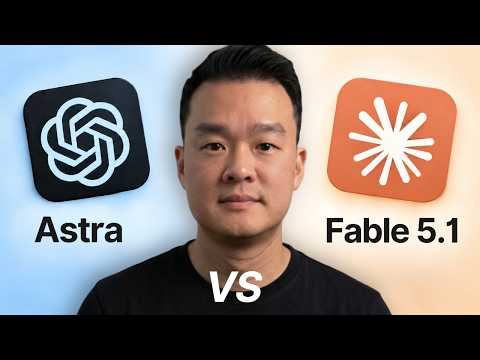
OpenAI Just Released An AI That Can Actually Do Your Work
Explore 10 practical ways GPT-6 Astra can perform real work, from controlling computers and building in Figma and Blender to analyzing products, organizing data, and automating complex workflows.
GPT-6 Astra is presented as more than a conventional AI chatbot. In this video, the creator and their team test how far Astra can go when it is given access to software, data, devices, and real-world workflows.
The demonstrations focus on practical applications including computer use, software automation, 3D development, design, content research, data organization, robotics, and product analysis.
1. Connect AI to Movement Data and 3D Models
The first demonstrations connect Astra to movement data and interactive 3D anatomy models. A variable tracks movement in areas such as the back and ankle and feeds that information into a visual 3D model.
Instead of looking at raw movement data, users can see how movement changes through an interactive visual representation.
2. Connect Astra to Physical Devices
Astra is also connected to a camera and robotic arm holding a paintbrush. The objective is to paint the Golden Gate Bridge.
The system evaluates previous attempts and adjusts subsequent attempts based on what it sees. Rather than manually programming every movement, the AI works toward a goal, observes the result, and improves its next attempt.
This demonstrates how AI agents can potentially interact with physical systems rather than remaining inside a chat interface.
3. Choose the Right Astra Mode
The video explains that Astra offers multiple reasoning modes, including light, medium, high, extra high, max, and ultra.
The recommended approach is to select the mode based on task complexity rather than always choosing the highest setting. Simpler tasks can use lighter modes, while complex coding and software workflows may benefit from higher reasoning levels.
4. Redesign an Existing Presentation
Astra can take an existing investor presentation and redesign its visual structure while preserving the underlying information.
The example involves improving:
- Layout
- Typography
- Colors
- Spacing
- Visual hierarchy
- Images and visual elements
- Overall presentation quality
The same workflow can be applied to sales decks, proposals, reports, college presentations, and other documents where the information is useful but the visual presentation needs improvement.
5. Recreate an Image Inside Figma
The video demonstrates Astra recreating a photograph as a brush painting directly inside Figma.
Instead of simply generating another image, Astra creates the artwork using individual brush strokes. The demonstrated result contains more than 27,000 brush strokes and can be replayed to show the image being constructed from a blank canvas.
This highlights Astra's ability to perform work directly inside existing creative software.
6. Analyze YouTube Thumbnails Before Creating One
Rather than immediately asking AI to generate a thumbnail, the video demonstrates a research-first workflow.
Astra analyzes a creator's existing thumbnails to identify patterns in:
- Faces
- Composition
- Colors
- Copy
- Visual style
- High-performing designs
It then creates a mood board and develops thumbnail concepts based on the creator's existing content.
The test analyzed around 130 thumbnails and used those references to create stronger thumbnail directions for a GPT-6 Astra video.
7. Use a Computer and Complete Multi-Step Tasks
Astra can also operate a computer through an iOS simulator.
In the demonstrated workflow, it opens Safari, accesses Uber, enters a journey from Apple Park to Google's Mountain View campus, finds available rides, and displays pricing.
Importantly, Astra stops before making the final purchase decision because it was not instructed to select a ride. This illustrates how users can allow AI to handle repetitive steps while retaining control over important decisions.
8. Build 3D Environments in Blender
Astra can connect to Blender through MCP and create detailed 3D environments.
Instead of immediately asking it to build an environment inspired by Winterfell from Game of Thrones, the video demonstrates a research-first approach.
Astra first studies reference material, including videos of the set, creates a research document, and then uses that research as the blueprint for the Blender build.
The same workflow can be applied to:
- Game environments
- Film sets
- 3D scenes
- Virtual worlds
- Architectural concepts
The central principle is simple: the more Astra understands before building, the less it has to guess.
9. Organize Social Media and Channel Data
Astra can connect to Google Sheets and organize information from platforms such as X and YouTube.
The example involves identifying AI-related accounts and organizing them into a searchable directory with information such as:
- Name
- Link
- Platform
- Category
- Subcategory
- Description
- Key details
Astra can also connect to analytics tools and analyze channel performance to identify content opportunities.
In the demonstrated YouTube research workflow, Astra reviewed channel uploads, analytics data, other relevant channels, and comment discussions before generating video ideas and a four-week publishing plan.
10. Research a Product Before Rebuilding It
The final example demonstrates one of the most powerful workflows: researching a complex product before attempting to recreate it.
Instead of simply telling Astra to "build Spotify," the workflow asks Astra to study the Spotify web and mobile applications screen by screen.
It maps:
- Screens
- User flows
- Interactions
- Features
- Data models
- API requirements
- Acceptance criteria
- Sign-in flows
- Product priorities
Astra can inspect both the web application and native iOS experience using computer access and iPhone mirroring.
The demonstrated research task ran for approximately 1 hour and 13 minutes and produced a detailed product research and rebuild document containing around 108 screen records, 176 interactions, 18 flowcharts, and additional product and technical documentation.
The Bigger Lesson
The main takeaway is that Astra becomes significantly more useful when it is treated as an AI agent rather than simply a chatbot.
Instead of asking only for an answer, users can:
- Define the desired outcome.
- Give Astra the information it needs.
- Connect the relevant tools.
- Provide appropriate permissions.
- Let Astra perform the workflow.
- Keep important decisions under human control.
- Ask Astra to research complicated products before rebuilding them.
This approach can make complex tasks involving design, coding, research, software, data, and computer use much more practical.