A blog post lands in your inbox from a freelancer. It reads well. Too well, maybe. The sentences are smooth, the structure is oddly perfect, and something about it just feels off.
You're not imagining it. Telling human writing apart from AI writing has become a real, everyday skill in 2026 — for teachers grading essays, editors reviewing freelance work, and publishers protecting their brand's voice. Here is the honest, no-jargon guide to spotting it, plus the tools that actually help.
Why Spotting AI Content Matters in 2026
AI writing tools have gotten good enough that most people can't tell the difference just by reading. That creates a few very real problems:
Search engines increasingly reward original, experience-backed content, so publishers need to confirm outsourced writing isn't raw AI output. Schools and universities need to verify student work is genuinely a student's own thinking, especially after AI-assisted cheating concerns escalated through 2024 and 2025. Businesses hiring freelance writers want to know they're paying for original thought, not a copy-paste job. And plenty of readers simply want to know if what they're reading came from a real person.
None of this means AI-written content is automatically bad — we've covered that debate in detail in Can AI Really Be Creative? It just means transparency matters, and having a reliable way to check is genuinely useful.
How AI Detectors Actually Work
AI content detectors are built on the same underlying technology as the AI writing tools they're trying to catch. Instead of predicting the next word to write a sentence, they're trained on huge datasets of both human and AI writing so they can learn to tell the two apart.
They mainly look at two signals: perplexity, which measures how predictable the word choices are (AI text tends to pick more statistically "expected" words), and burstiness, which measures how uniform sentence length and structure are (human writing naturally varies more).
The catch is that as AI models like GPT-5, Claude, and Gemini get better at mimicking natural human rhythm, detectors have to keep retraining just to keep up. It's a constant back-and-forth, not a solved problem.
How to Spot AI-Generated Content Manually
Before you even open a detector tool, a few patterns are worth training your eye to catch:
Too-perfect structure. AI writing tends to follow predictable patterns — even paragraph lengths, similar sentence rhythms, and a "textbook" flow that real writers rarely stick to.
Generic phrasing. Watch for vague, safe language that doesn't commit to a specific opinion or detail.
Repetitive sentence starters. Real writers vary how they open sentences. AI output often falls into repeating patterns.
Overuse of certain transition words. Words like "moreover," "furthermore," and "in conclusion" show up far more often in AI writing than in casual human writing.
Lack of personal detail. AI can't reference a real memory, a specific client conversation, or a genuine mistake it made — humans naturally do.
These signs aren't proof on their own. That's where detector tools come in.
Best AI Detector Tools in 2026
Here are the tools worth trying, based on what each is best known for right now.
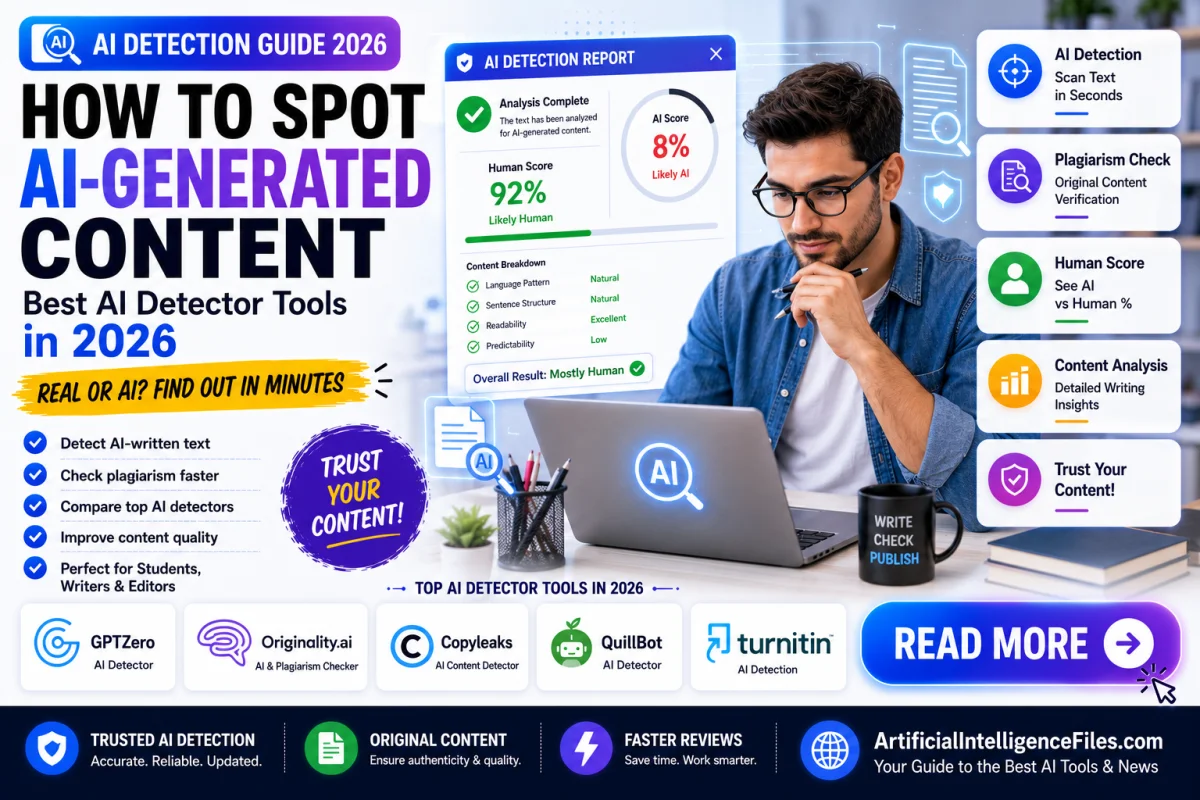
Originality.ai — a favorite among publishers and content teams because it checks for AI writing and plagiarism in the same scan. Independent testing in 2026 has consistently placed it among the highest-accuracy detectors for long-form English text, and it's a strong pick for anyone managing content at scale rather than doing one-off checks.
GPTZero — one of the most widely used detectors, especially popular with teachers, thanks to its budget-friendly pricing and integration with common classroom and learning-management tools.
Copyleaks — built to handle large volumes of text and gives a sentence-by-sentence breakdown, making it easy to see exactly which parts of a document look AI-written rather than just an overall score.
QuillBot Detector — a genuinely free option with no signup required, a solid pick if you just want a quick one-off check.
Turnitin AI Detection — built directly into the plagiarism-checking workflow most colleges and universities already use, which is why it's become the default choice for academic institutions.
Sapling — updates its detection models frequently to keep pace with new AI releases, which helps it stay accurate even as models like ChatGPT and Claude keep improving.
Pangram — a newer entrant that independent university testing has highlighted for an unusually low false-positive rate, even against text run through "humanizer" tools, making it a strong choice when accuracy matters more than speed.
How Accurate Are AI Detectors, Really?
Here's the honest part: no AI detector is 100% accurate, and none of them ever will be. Leading tools like Originality.ai, GPTZero, and Copyleaks claim accuracy rates above 95% on long-form English text, but real-world testing tells a more nuanced story — false positive rates on polished human writing can still run anywhere from 5% to 15% depending on the tool and the writing style being tested.
Two failure modes are worth knowing:
False positives. Some detectors flag well-structured, formal human writing as AI-generated, especially from writers with a clean, methodical style.
False negatives. Heavily edited AI text, or text run through a dedicated "humanizer" tool, can sometimes slip past detection entirely.
A smart threshold-based approach works best: treat a single detector score as one signal, not a final verdict. For low-stakes checks, a 70% confidence score might be enough for a quick first pass. For anything with real consequences — a grade, a hiring decision, rejecting a freelancer's work — look for 90%+ agreement across at least two different tools, plus a manual read using the signs above.
Quick Tips If You're Checking Content Regularly
Use a detector as a first-pass filter, not the only check. Set a higher confidence threshold before treating something as "confirmed AI." Combine automated checks with a quick manual read using the red flags covered earlier. And recheck occasionally with a different tool, since accuracy varies model to model and shifts as AI writing tools themselves keep evolving.
Final Thoughts
AI detector tools aren't perfect, but they're a genuinely useful starting point whether you're an editor, a teacher, or just a curious reader. Pair a good detector with the manual signs above, and you'll get a far clearer picture of what's genuinely human-written and what isn't.
Want to explore more AI tools like these? Check out our full AI Tools directory for free and paid options across every category, or browse more guides like this one on our AI Blogs page.
Want to stay updated on the latest AI tools, detectors, and news as they happen? Visit ArtificialIntelligenceFiles.com — your simple, honest guide to everything happening in AI right now, updated every week.
Frequently Asked Questions (FAQs)
Q1. Can AI detectors be 100% accurate?
No. Every detector on the market can produce false positives (flagging human writing as AI) or false negatives (missing AI writing). Leading tools claim above 95% accuracy on long-form English text, but real-world false positive rates can still run 5–15% depending on the writing style. Treat results as a strong signal, not absolute proof.
Q2. Are free AI detector tools good enough to use?
For a quick, casual check, yes — tools like QuillBot Detector and GPTZero's free tier work well. For high-stakes decisions like grading, hiring, or publishing, a paid tool with combined plagiarism checking, like Originality.ai, is more reliable and worth the cost.
Q3. Can AI detectors tell which AI tool was used to write something?
Most tools simply tell you whether text looks AI-generated or human-written, without naming the specific model. A few newer tools attempt model-level attribution, but this is far less reliable than the basic AI-vs-human detection score.
Q4. Do AI detectors work on edited or "humanized" AI content?
It depends. Lightly edited AI text is often still detectable. Heavily rewritten or "humanized" AI content, run through tools designed specifically to evade detection, can sometimes pass undetected — which is exactly why manual checks and multi-tool verification still matter.
Q5. Which AI detector is best for teachers and schools?
Turnitin AI Detection is the most widely used option in academic settings since it's built directly into the plagiarism-checking workflow most institutions already use. Some schools layer GPTZero or Copyleaks alongside it for a second opinion, since different detection models can disagree on the same piece of writing.