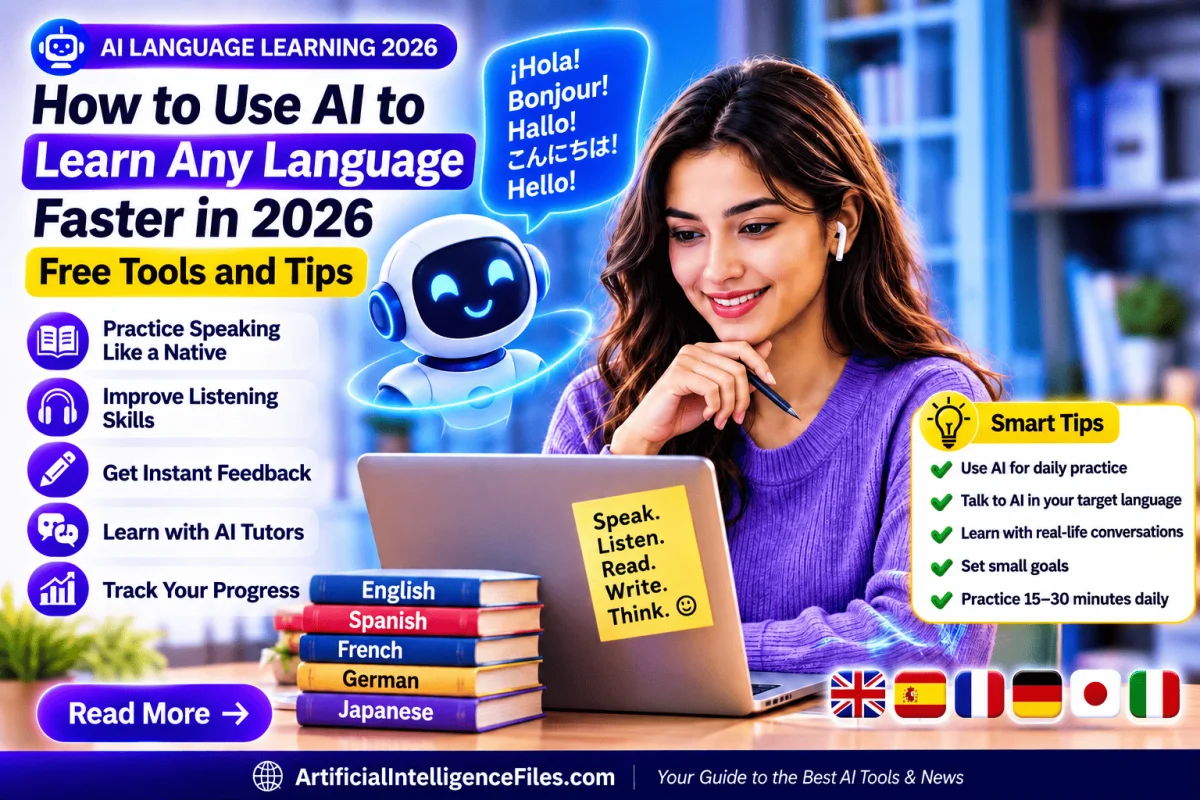
Learning a new language used to mean expensive tutors, awkward language exchange meetups, or grinding through textbook exercises alone at your desk.
AI changed the equation completely.
Today you can have a full conversation in Spanish at 2am in your pyjamas with a tutor that never judges you, never gets tired, adjusts to your exact level, corrects your mistakes instantly, and costs nothing. That is genuinely revolutionary for anyone who has ever wanted to learn a language but hit a wall.
But the AI language learning space is also full of hype. Every app claims to use AI — even when the feature is just a slightly smarter flashcard shuffler. This guide cuts through all of that and tells you exactly which tools actually work, how to use them, and what realistic progress looks like in 2026.
Why AI is a Game Changer for Language Learning
The biggest barrier to learning a new language has never been grammar books or vocabulary lists. It has always been practice — specifically, the lack of someone patient enough to let you stumble through broken sentences, correct you gently, and keep going until it clicks.
A private tutor who does all of that costs $30 to $80 per hour. Most people cannot afford daily sessions. And language exchanges with native speakers — while valuable — require finding the right person, scheduling time, and dealing with the mutual awkwardness of two people practising on each other.
AI removes all of those barriers. You get a patient, available conversation partner 24 hours a day, at every proficiency level, in virtually any language, for free or at a fraction of the cost of a human tutor.
AI is also genuinely better than most language apps at one specific thing: producing the fluency that only comes from real conversation. Most apps — including Duolingo — are excellent at building vocabulary and teaching grammar rules. But they cannot simulate the real experience of forming sentences in real time under conversational pressure. AI can.
1. ChatGPT — Best Free AI Language Tutor Overall
Free plan: Yes — no credit card required Voice mode: Available on free plan (limited) and fully on Plus at $20/month Languages: 50+ including all major languages Link: chatgpt.com
ChatGPT is the most powerful free language learning tool available in 2026 — and most people are not using it this way. With the right prompt, it becomes a personal tutor available any time, at any level, in any language.
The voice mode is where ChatGPT transforms language learning completely. You speak, ChatGPT responds in your target language, you continue the conversation. When you make a mistake, you can ask "was that correct?" and get an immediate, clear explanation. It is remarkably close to talking with a patient native-speaker tutor.
Here are the copy-paste prompts that work best:
For conversation practice: "You are my Spanish conversation partner. Speak to me in Spanish at a beginner level. After each exchange, briefly note any grammar or vocabulary mistakes I made. Keep the conversation going naturally."
For structured tutoring: "Act as a patient French tutor. Have a conversation with me entirely in French. My level is A2 (elementary). When I make a grammar mistake, gently correct me in French, then briefly explain the correction in English. Keep the conversation going. Start by asking me about my day."
For grammar explanations: "Explain the difference between the preterite and imperfect tenses in Spanish. Give me 5 example sentence pairs showing when to use each one. Then quiz me with 5 fill-in-the-blank sentences."
For vocabulary in context: "I am learning Japanese at N4 level. Give me 10 practical phrases I would use in a convenience store, with the Japanese characters, the romanised pronunciation, and an English translation for each one."
The key detail that makes these prompts work is specificity — always include your proficiency level, the correction style you want, and whether you want responses in the target language or a mix. Without these, ChatGPT either pitches the conversation too high or does not correct your errors at all.
2. Duolingo — Best Free App for Building Daily Habits
Free plan: Yes — generous free tier Languages: 40+ languages Link: duolingo.com
Duolingo is the most downloaded language learning app in the world — and in 2026, it has genuinely improved with AI. The new Adventure mode uses generative AI to create story-based lessons unique to each user, dropping you into scenarios — ordering food, navigating a train station, negotiating a deal — that feel interactive rather than mechanical.
Duolingo Max, the premium tier, adds Roleplay and Explain My Answer features powered by GPT-4. Roleplay creates open-ended conversation scenarios. Explain My Answer gives you a clear breakdown of why your answer was right or wrong. Both features are currently available primarily for Spanish and French learners — with more languages being added throughout 2026.
The honest limitation: Duolingo builds vocabulary and grammar instincts brilliantly, but it does not develop real speaking fluency on its own. It is best used as a daily habit-builder and vocabulary supplement — not as your primary conversation practice tool. Combine it with ChatGPT voice mode for the most effective free combination.
Best for: Beginners who need structure and gamification to build a daily habit. If you have never stuck with language learning before, Duolingo's streak system is your best shot at consistency.
3. Claude — Best Free AI for Detailed Language Explanations
Free plan: Yes — no credit card required Languages: All major languages Link: claude.ai
Claude is the tool to reach for when ChatGPT's explanation is not quite clicking. Where ChatGPT is slightly more conversational and playful, Claude produces more detailed, patient, and carefully structured language explanations — exactly what you need when you are genuinely stuck on a grammar concept.
Ask Claude to explain why a particular sentence is structured the way it is, to give you a complete breakdown of a verb conjugation pattern, or to analyse a piece of writing you have produced and explain every correction it suggests. The level of detail in its explanations is outstanding.
Claude is also excellent at producing custom study materials — vocabulary lists organised by topic, fill-in-the-blank exercises, grammar tables, and reading passages at a specific difficulty level. Give it your target language, your current level, and the topic you are studying — and it builds material in minutes that would take hours to find and assemble from textbooks.
Best for: Learners who want deep, detailed grammar explanations and custom study materials rather than conversation practice.
4. Duolingo Max and Hello Nabu — Best AI Apps for Structured Learners
Hello Nabu free plan: Yes — full free path available Link: hellonabu.com
Hello Nabu is one of the most complete free AI language learning apps available in 2026 — offering story-based lessons, instant pronunciation feedback, grammar in context, and CEFR-aligned progression in a single flow. In independent comparisons, it consistently ranks as the strongest completely free option for learners of English, Spanish, French, German, Italian, and Portuguese.
What sets it apart from both Duolingo and generic AI chatbots is the combination of structure and conversation. You are not just drilling flashcards, and you are not just having an unguided chat — you are moving through a curriculum designed to build real fluency, with AI correction at every step.
Best for: Learners who want a complete free curriculum rather than assembling their own study plan from multiple tools.
5. ELSA Speak — Best Free AI for Pronunciation
Free plan: Yes — core pronunciation features free Link: elsaspeak.com
ELSA Speak is the best specialised tool for pronunciation in 2026. It uses AI to analyse exactly how you pronounce words and sounds — not just telling you whether your answer was right or wrong, but identifying the specific phonemes you are mispronouncing and giving you targeted exercises to fix them.
For learners whose biggest challenge is accent and pronunciation rather than grammar or vocabulary — particularly learners of English, Spanish, French, or Japanese — ELSA provides feedback at a level of detail that no general AI tool can match.
Best for: Intermediate learners who have solid grammar and vocabulary but want to dramatically improve their pronunciation and accent.
6. Talkio and Praktika — Best for Structured Conversation Practice
Talkio link: talkio.ai Praktika link: praktika.ai
Both Talkio and Praktika are paid AI conversation tools — but worth mentioning for learners who find free-form ChatGPT conversations too unstructured.
Talkio provides AI tutors for 40+ languages with dialect support — you can choose Mexican Spanish versus Spain Spanish, Brazilian Portuguese versus European Portuguese. For learners who need regional specificity, this matters significantly.
Praktika specialises in scenario-based practice — specific real-world situations like job interviews, restaurant conversations, or hotel check-ins. If you are learning a language for a specific trip or professional context, Praktika's scenario focus accelerates progress faster than open-ended conversation practice.
Both offer free trials to test before committing to a subscription.
The Most Effective Free AI Language Learning System in 2026
Here is the exact combination that independent language learning researchers and practitioners consistently recommend in 2026 — using only free tools.
Daily 5 minutes — Duolingo for vocabulary reinforcement and grammar instincts. Use it while waiting in queues, during commutes, or first thing in the morning. This builds the daily habit that most language learners struggle to maintain.
Daily 15 to 20 minutes — ChatGPT voice mode for conversation practice. Use the structured prompts above. Speak in your target language for the full session. Ask for corrections at the end of each exchange. This is the single highest-value activity for developing actual speaking fluency.
Weekly — Claude for grammar deep-dives. When something is not clicking — a tense, a grammatical structure, a vocabulary distinction — ask Claude for a complete, detailed explanation with examples. Spend 20 to 30 minutes going deep on one concept per week.
Monthly — a language exchange. Once you have built confidence through AI practice, test your skills with real native speakers through Tandem or HelloTalk — both free. Real humans provide cultural nuance, slang, and authentic conversational pressure that AI cannot fully replicate.
This combination — Duolingo for habits, ChatGPT for speaking, Claude for understanding, humans for authenticity — covers every dimension of language learning at essentially zero cost.
How Long Does It Actually Take?
Here is the honest timeline — AI speeds things up, but it does not eliminate the time investment.
For a Romance language like Spanish, French, or Italian — where your native language shares vocabulary and grammatical structure — basic conversational ability takes 6 to 12 months of 30 minutes daily practice. AI accelerates this by providing unlimited speaking practice that most learners previously could not access.
For more distant languages like Japanese, Mandarin, Arabic, or Korean — the timeline is 18 to 36 months for real conversational ability. AI is particularly valuable here because finding conversation partners for less common languages is harder, and AI tutors are available in any language at any time.
For tourist-level communication in a language — enough to order food, ask for directions, and handle basic transactions — 4 to 8 weeks of consistent daily practice with AI tools is genuinely achievable for most people.
Honest Limitations of AI for Language Learning
AI is not perfect for language learning — and being honest about the gaps helps you use it most effectively.
Latest slang and colloquialisms may not be perfectly accurate. AI models have training cutoffs, and the newest expressions, regional slang, and internet language may not be well represented. For casual contemporary speech, supplementing with real media — films, music, social media — in your target language remains important.
Less common languages have uneven AI support. For Spanish, French, German, Japanese, Chinese, and Arabic — AI tools in 2026 are excellent. For less widely spoken languages, quality drops significantly and dedicated resources matter more.
Real conversational pressure — the speed, unpredictability, and cultural context of talking with a real native speaker — is something AI simulates well but does not perfectly replicate. The monthly language exchange recommendation above specifically addresses this gap.
Final Thoughts
AI has made it genuinely possible to learn a language from scratch — at any age, in any location, on any budget — in a way that simply was not true three years ago. The combination of ChatGPT voice mode for speaking, Duolingo for daily habits, and Claude for deep understanding gives most learners everything they need for a fraction of the cost of traditional methods.
Pick your target language. Use the prompts in this guide to set up your first ChatGPT conversation session today. Start speaking on day one — not after you have learned enough grammar to feel ready. That moment never arrives. The speaking is how you learn.
Want to discover more free AI tools, guides, and the latest AI news? Visit ArtificialIntelligenceFiles.com — your simple guide to everything happening in AI right now, updated every week.
Frequently Asked Questions (FAQs)
Q1. Can AI really teach me a language in 2026?
Yes — AI can dramatically accelerate language learning, particularly for speaking and conversation practice. ChatGPT voice mode, Claude, and dedicated apps like Duolingo and Hello Nabu provide unlimited, personalised practice that used to require expensive human tutors. However, AI works best as a practice partner rather than a complete standalone solution. Supplementing with real human conversations and authentic media in your target language accelerates progress further.
Q2. Is ChatGPT or Duolingo better for language learning?
They serve different purposes and work best in combination. Duolingo excels at building daily habits, teaching vocabulary, and developing grammar instincts through gamification. ChatGPT excels at free-form conversation practice, grammar explanations, and custom study materials. For speaking fluency — the skill most language learners actually want — ChatGPT voice mode is significantly more effective than Duolingo alone. The best system uses both: Duolingo for daily vocabulary habits and ChatGPT for conversation practice.
Q3. What is the best free AI tool for learning Spanish in 2026?
The most effective free combination for Spanish in 2026 is ChatGPT for conversation practice using the structured prompts in this guide, Duolingo free tier for daily vocabulary building, and Claude for grammar explanations when something is not clicking. Hello Nabu is also an excellent free structured option if you prefer an app-based curriculum over self-directed ChatGPT sessions. All four are free to start with no credit card required.
Q4. How do I use ChatGPT to practise speaking a foreign language?
Enable voice mode in the ChatGPT app on your phone and use this prompt to start: "You are my [language] conversation partner. Speak to me in [language] at [your level — beginner/intermediate/advanced] level. After each exchange, briefly note any grammar or vocabulary mistakes I made. Keep the conversation going naturally." Speak out loud for 15 to 20 minutes per session. Ask "was that correct?" any time you are unsure. This single method provides more speaking practice in a week than most traditional learners get in a month.
Q5. How long does it take to learn a language using AI tools in 2026?
For Romance languages like Spanish and French, basic conversational ability takes 6 to 12 months of 30 minutes of daily AI-assisted practice. For more distant languages like Japanese, Mandarin, or Arabic, expect 18 to 36 months for real conversational ability. For basic tourist-level communication in any language, 4 to 8 weeks of consistent daily practice is achievable for most people. AI accelerates this timeline by providing unlimited speaking practice — but it does not eliminate the time investment required to build genuine fluency.