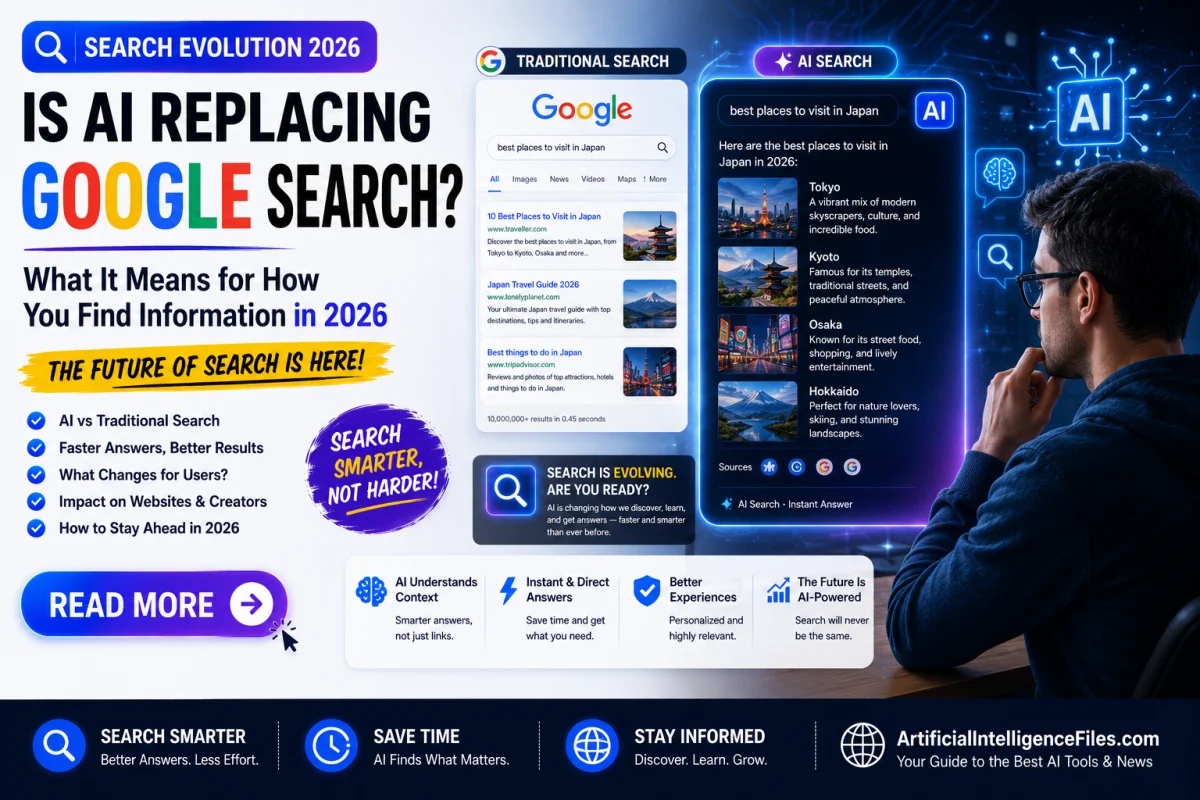
You have probably noticed it yourself. Instead of typing something into Google, you find yourself asking ChatGPT instead. Or opening Perplexity. Or just asking Gemini right inside your browser.
You are not imagining it. Search behaviour is genuinely changing — and faster than most people realise. But here is the thing most headlines get completely wrong — AI is not replacing Google. It is doing something much more interesting than that.
Let us look at what is actually happening, what the real data shows, and what it means for how you find information every day in 2026.
First — How Big is Google Actually?
Before anyone can claim AI is replacing Google, it helps to understand just how enormous Google still is.
Google processes 16.4 billion searches every single day. It holds between 89% and 93% of global search market share in 2026 — virtually unchanged from 93% in 2022. Traditional search traffic has only declined by 0.5% over the past two years.
Compare that to ChatGPT, which processes around 2 billion queries per day globally and has around 800 million weekly active users. Impressive numbers — but Google still handles roughly eight times more queries every single day.
So when someone says "AI is killing Google" — the data simply does not support it. Not yet. Not even close.
But Something Real IS Changing
That does not mean nothing is happening. Something very significant is shifting — just not the way most headlines describe it.
37% of consumers now start certain searches with an AI tool rather than Google. Among people under 30, 82% have used AI chatbots for search purposes. Among business software buyers, 51% now start their research with an AI chatbot more often than with Google — up from just 29% eleven months earlier. And 44% of people say AI tools have genuinely changed how they look for information online.
These are not small numbers. Something real is changing. But the key word is how — not whether — people use these tools.
The Real Story — AI and Google Are Splitting the Job
Here is the most important insight from 2026 search data — and the one almost nobody is talking about clearly.
AI tools and Google are not competing for the same searches. They are splitting the job of finding information into two distinct categories.
Google is for fast, specific, everyday lookups. Store hours. Product prices. Breaking news. Train times. The name of that actor in that film. These are quick, high-frequency searches where you already know roughly what you are looking for and you want a direct answer or a list of links to choose from. Google processes tens of billions of these every day and does them exceptionally well.
AI tools are for deeper, more complex research. Comparing options. Synthesising information from multiple sources. Getting a nuanced explanation of a complicated topic. Planning a trip from scratch. Working through a business decision. Getting advice tailored to your specific situation. These are the slower, more thoughtful searches where you do not just want links — you want understanding.
Research from ZipTie.dev found that the average Google search session lasts around 6 minutes with about 200 searches per month. The average ChatGPT session lasts over 13 minutes with around 15 queries per month. People go to Google often, briefly, for specific things. They go to AI tools less often but for much longer, more complex conversations.
The two tools are not replacing each other. They are splitting the work.
ChatGPT vs Google — Which is Actually Better in 2026?
The honest answer is that they are better at different things — and trying to pick a winner is the wrong way to think about it.
Google is better for:
Finding a specific website or page you already know exists. Getting the most current breaking news from the past few hours. Local searches — restaurants near you, shop opening times, directions. Price comparisons across multiple retailers. Anything where you want to choose from a list of sources rather than get one synthesised answer.
AI tools like ChatGPT, Claude, and Perplexity are better for:
Understanding a complex topic from scratch. Getting a complete, synthesised answer without having to click through ten different websites. Research that requires comparing multiple perspectives. Writing assistance, brainstorming, and creative tasks. Asking follow-up questions that build on previous answers in the same conversation.
Perplexity specifically sits in an interesting middle ground — it searches the web in real time like Google but presents the results as a synthesised, conversational answer like ChatGPT. Many users in 2026 use it as their default for research because it combines the freshness of Google with the clarity of AI-generated answers.
How People Are Actually Searching Differently in 2026
The shift is not just about which tool people use. It is about how they phrase their searches.
On Google, people type short fragments. "Best laptop 2026." "Weather tomorrow." "ChatGPT review." Three to five words, designed to match keywords.
On AI tools, people write full sentences and describe their entire situation. "I am a student in the UK looking for a budget laptop under £600 for university, mainly for coding and writing essays — what should I buy and why?" That is a completely different kind of search — and it produces a completely different kind of answer.
AI queries average 23 words compared to 4 words on traditional Google. People are not just switching tools. They are learning to ask better questions — and getting better answers as a result.
Will AI Kill Google? The Honest Answer
No — but it will force Google to evolve faster than at any point in its history. And it already is.
Google's response to the rise of AI search has been AI Overviews — the AI-generated summaries that now appear at the top of many Google search results pages. Instead of showing ten blue links, Google now often shows a synthesised AI answer first, with links below for people who want to go deeper.
This is Google doing what it has always done — adapting to how people want to find information and staying the dominant platform for search. It is working. Google's overall search volume has not collapsed. It has barely dipped. But the experience of searching on Google in 2026 already looks significantly different from 2022 because of AI.
Gartner predicts that traditional search volume will decline by 25% by the end of 2026. That is a significant number — but it still leaves the vast majority of searches happening on Google. And McKinsey projects that $750 billion in consumer spending will flow through AI-powered search by 2028 — which tells you that AI search is becoming commercially important, not just a curiosity.
What This Means for You Practically
Here is the most useful takeaway from all of this data — a simple framework for deciding which tool to use depending on what you are trying to do.
Use Google when you want a specific website, need the latest breaking news, are looking for something local, want to compare prices across shops, or need to find an exact piece of content you know exists somewhere online.
Use ChatGPT or Claude when you want to understand something complex, need a detailed explanation written in plain language, are working through a multi-step problem, want help writing something, or need advice tailored to your specific situation.
Use Perplexity when you want a synthesised research answer with real sources cited, need information that may have changed recently, or want the benefits of both Google's freshness and AI's clarity in a single answer.
Use Google Gemini when you are already working inside Gmail, Google Docs, or Google Drive and want AI assistance without switching apps.
The smartest searchers in 2026 do not pick one tool and use it for everything. They match the tool to the task — and get dramatically better results because of it.
Final Thoughts
Is AI replacing Google search? Not replacing — reshaping.
Google is not dying. It is changing. AI search tools are not taking over — they are filling a gap that Google was never perfectly designed for. The result is a more interesting, more useful information landscape than we have ever had before.
The average person in 2026 who understands when to use Google versus when to use AI gets answers faster, understands topics more deeply, and makes better decisions than someone who stubbornly sticks to just one tool.
That understanding is genuinely valuable. And now you have it.
Want to stay updated on the latest AI tools, search trends, and news as they happen? Visit ArtificialIntelligenceFiles.com — your simple, honest guide to everything happening in AI right now.
Frequently Asked Questions (FAQs)
Q1. Is AI actually replacing Google search in 2026?
No — not replacing, but reshaping. Google still processes 16.4 billion searches per day and holds around 90% of global search market share. AI tools like ChatGPT are growing rapidly but serve a different purpose — deeper research and synthesis rather than quick lookups. The two are splitting the job of finding information rather than one replacing the other.
Q2. Is ChatGPT better than Google for searching?
It depends entirely on what you are searching for. ChatGPT is better for complex research, understanding difficult topics, getting synthesised explanations, and multi-step problem solving. Google is better for quick specific lookups, finding exact websites, local searches, current news, and price comparisons. The smartest approach in 2026 is using both for different tasks.
Q3. What percentage of people use AI instead of Google in 2026?
37% of consumers now start certain searches with an AI tool rather than Google. Among people under 30, 82% have used AI chatbots for search. Among business buyers, 51% now start their research with AI more often than Google. However, Google still handles far more total daily searches than all AI tools combined.
Q4. What is Perplexity AI and why are people switching to it?
Perplexity AI is a search engine that combines real-time web searching with AI-generated answers. Instead of showing a list of links like Google, it searches multiple sources and presents a clear, synthesised answer with citations. Many users prefer it for research because it gives the freshness of Google with the clarity of an AI explanation — all in one place. You can try it free at perplexity.ai.
Q5. Will Google eventually be replaced by AI search?
Most experts and current data suggest no — at least not in the foreseeable future. Google is actively integrating AI into its own search experience through AI Overviews, and its infrastructure advantage is enormous. What is more likely is that Google continues to evolve into a hybrid tool that combines traditional search with AI synthesis — rather than being replaced by a separate AI tool entirely. The search landscape of 2030 will look different from today, but Google will almost certainly still be a major part of it.