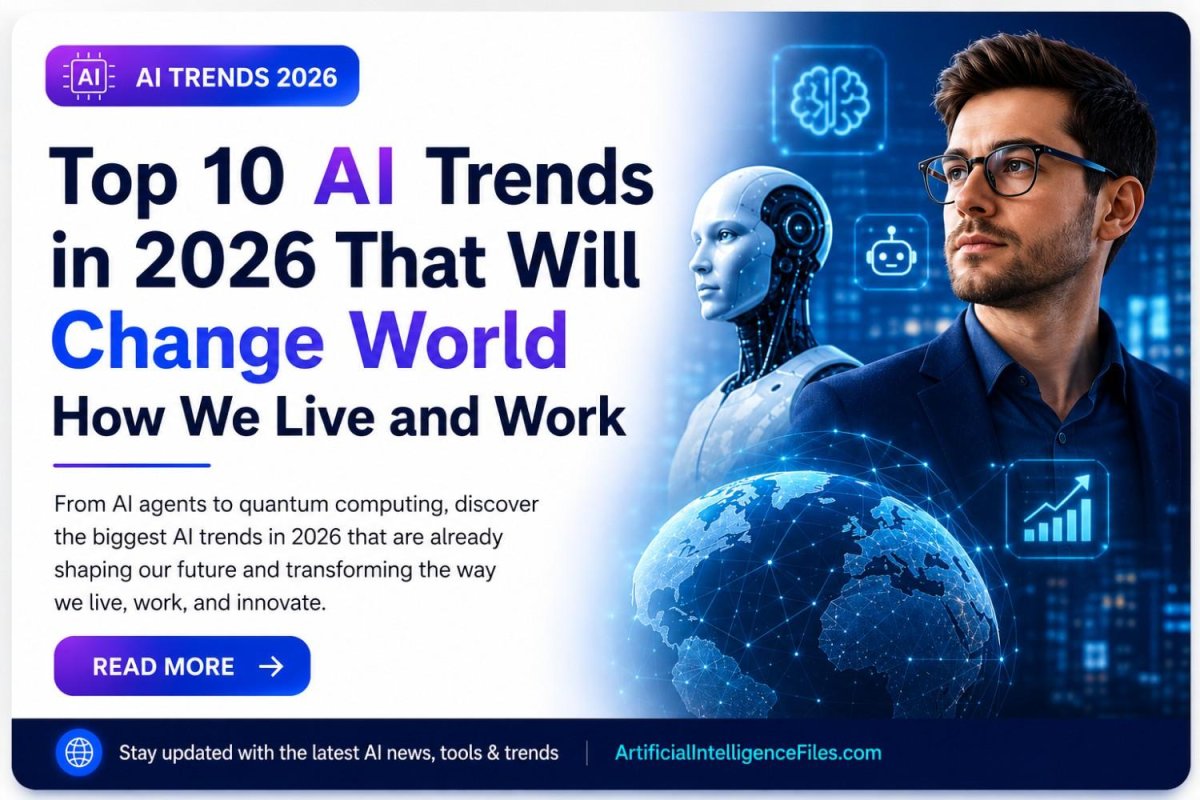
If you think AI is already impressive today, wait until you see what is happening in 2026.
This year, AI is not just a tool you type questions into. It is becoming a partner that thinks, plans, and works alongside you. It is entering hospitals, schools, factories, and homes in ways that were hard to imagine just two years ago.
Here are the top 10 AI trends in 2026 that are already changing how we live and work — explained in simple, easy language.
1. AI Agents Are Taking Over Boring Tasks
The biggest AI trend of 2026 is the rise of AI agents — software that does not just answer questions but actually takes action on your behalf.
An AI agent can browse the web, write an email, book a meeting, and manage your files all by itself without you lifting a finger. Think of it as a digital assistant that actually gets things done, not just one that gives you advice. Gartner predicts that 40% of business software will use AI agents by the end of 2026, compared to less than 5% in 2025. You can try AI agents today through tools like ChatGPT and Google Gemini, both of which now offer agent-like features on their free plans.
2. AI Is Getting Smarter at Reasoning
Earlier AI tools would give you an answer instantly — but sometimes that answer was wrong. In 2026, a new type of AI called reasoning AI takes time to think before responding.
Instead of guessing, it works through the problem step by step — much like how a careful student double-checks their work before handing it in. This makes AI far more reliable for complex tasks like solving math problems, writing legal documents, and making medical decisions. OpenAI's o3 and Claude are two of the best examples of reasoning AI you can use right now.
3. AI Can Now See, Hear, and Read at the Same Time
Most people know AI can read and write text. But in 2026, the biggest AI models are multimodal — which means they can understand text, images, audio, and video all at once.
You can show an AI a photo of a broken machine and ask what is wrong with it. You can upload a video of your cooking and ask for feedback. You can send a voice note and get a written summary back. Google Gemini and ChatGPT are both multimodal today and completely free to try. This makes AI useful in ways that go far beyond chatting on a screen.
4. AI Is Becoming Your Personal Health Assistant
One of the most exciting new AI technologies coming in 2026 is AI in healthcare. AI tools are now helping doctors catch diseases earlier, read medical scans more accurately, and suggest better treatments based on a patient's full history.
For everyday people, AI health apps can track symptoms, remind you to take medication, and flag warning signs before they become serious. Tools like Ada Health let anyone check their symptoms using AI for free. In many countries, AI is already helping close the gap in healthcare access for people who live far from hospitals or cannot afford a doctor.
5. AI Is Writing Code — and Lots of It
If you have heard about tools like GitHub Copilot or Claude Code, you already know that AI is helping developers write software faster than ever. But in 2026, this has gone much further.
AI can now read an entire software project, find bugs, fix them, and suggest improvements — all without a human telling it exactly what to do. Even people with no coding experience can now build working apps using platforms like Replit and Lovable — both of which are free to start. This is completely changing what it means to be a developer.
6. Humanoid Robots Are Being Trained by AI
This one sounds like science fiction, but it is real. In 2026, companies are using AI to train humanoid robots — machines that walk and move like humans — by recording how real people complete tasks and feeding that footage to the robots.
Companies like Tesla with their Optimus robot and Figure AI are leading this space. These robots are being tested in warehouses, construction sites, and factories to handle tasks that are dangerous or physically exhausting for humans. The progress being made this year is faster than almost anyone expected.
7. AI Is Speeding Up Scientific Research
Scientists used to spend years running experiments and reading thousands of research papers. In 2026, AI is becoming a true lab assistant — one that can suggest new experiments, analyse results, and even help discover new medicines and materials.
Microsoft Research and Google DeepMind are both heavily investing in this space. AI is already making breakthroughs in climate science, cancer research, and materials discovery that would have taken human teams many more years to reach.
8. Countries Are Racing to Control AI
AI is no longer just a tech industry conversation. In 2026, governments around the world are creating laws and policies to control how AI is used, who owns it, and how it is kept safe.
The European Union's AI Act is now coming into full effect this year, setting strict rules for how AI can be used in sensitive areas like healthcare, education, and hiring. In the US, new laws are being debated to protect people from harmful uses of AI like deepfakes and data misuse. This trend — called AI governance — is one of the biggest topics in global politics right now.
9. Quantum Computing Is Getting Closer to Reality
Quantum computing has been a future promise for many years. But in 2026, IBM has publicly stated that quantum computers are reaching a point where they can solve certain problems faster than any traditional computer ever could.
Microsoft is also pushing forward with hybrid quantum systems that combine AI and quantum computing together. When these two technologies work together, the results could be extraordinary — solving medical, environmental, and financial challenges that are currently impossible to crack. This is still early days, but 2026 is the year it stopped feeling like science fiction.
10. AI Is Becoming Something Anyone Can Build With
Perhaps the most important AI trend in 2026 is who is using it. AI is no longer only for big tech companies or expert programmers. Everyday people — teachers, shopkeepers, designers, farmers, and students — are now building their own AI-powered tools using simple platforms that require no technical background.
Platforms like Canva AI, Notion AI, and Make let anyone automate tasks and build AI-powered workflows for free. This democratisation of AI means that the benefits of this technology are spreading faster and wider than ever before. The future of artificial intelligence in 2026 is not just about smarter machines — it is about more people having access to smarter tools.
Final Thoughts
2026 is a turning point for AI. It is moving from something we experiment with to something we genuinely depend on — in our work, our health, our science, and our daily lives.
Whether you are a student, a business owner, or just someone curious about the future, understanding these trends will help you stay ahead and make the most of what AI has to offer.
Want to stay updated on the latest AI news, tools, and trends as they happen? Visit ArtificialIntelligenceFiles.com — your simple guide to everything happening in AI right now.