Something has quietly changed about how people find information online — and most website owners have not caught up yet.
When someone wants to know the best laptop under $500, or how to fix a leaking tap, or what prompt engineering is — a growing number of them are not going to Google and clicking through websites. They are asking ChatGPT, searching on Perplexity, or reading the AI Overview that appears at the top of their Google results page before they see a single link.
ChatGPT now handles 2 billion queries every day. Google AI Overviews appear in 55% of all Google searches. Perplexity has crossed 100 million users. Gartner predicts traditional search volume will decline by 25% by the end of 2026.
The question is no longer just "how do I rank on Google?" It is "how do I get AI to cite my content when it answers a question?"
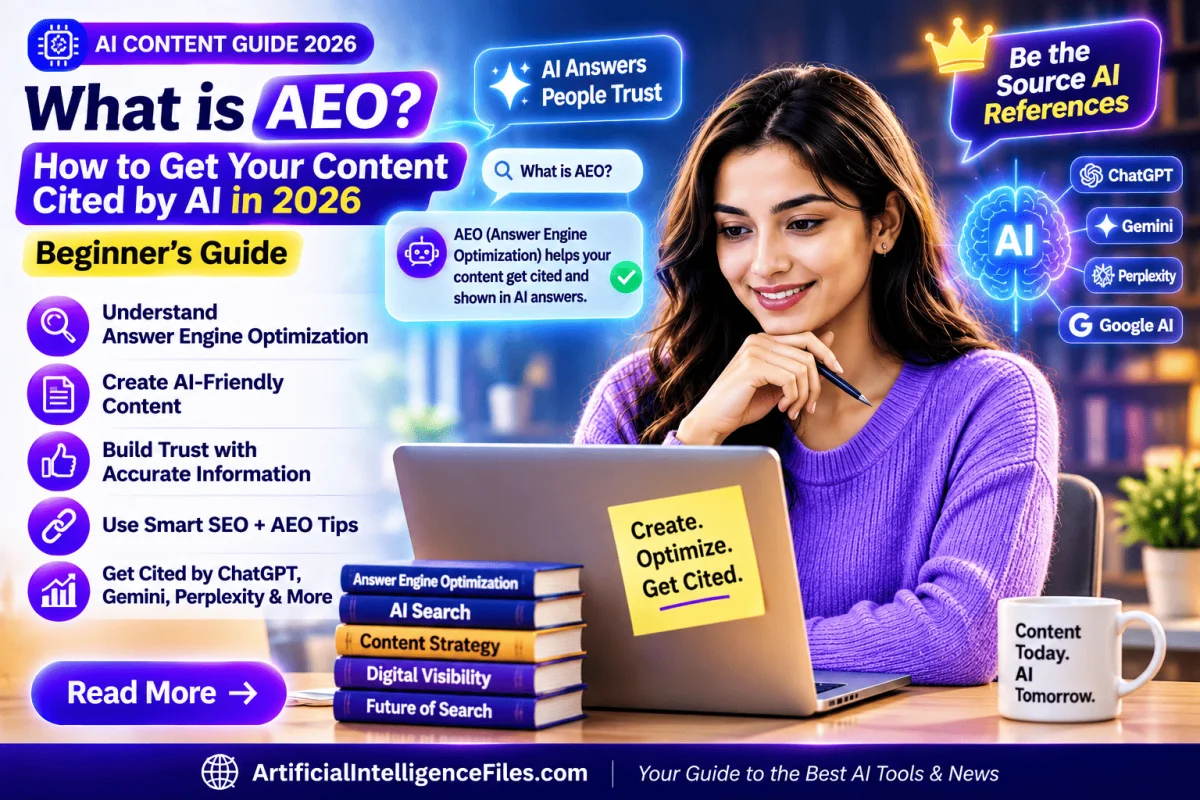
That is what Answer Engine Optimization — AEO — is about. And this guide explains it from scratch.
What is Answer Engine Optimization (AEO)?
Answer Engine Optimization is the practice of structuring your content so that AI-powered platforms — ChatGPT, Perplexity, Google AI Overviews, Claude, and Microsoft Copilot — can extract, trust, and cite it when they generate answers to user questions.
Traditional SEO got you a ranking position — a spot in Google's list of ten blue links. The goal was to get the click.
AEO gets you a citation — your content quoted, paraphrased, or linked inside an AI-generated answer. The goal is to be the source the AI chooses when it composes its response.
This is a different goal, and it requires different thinking about how you write and structure content.
You may also see this called GEO — Generative Engine Optimization — which is essentially the same concept with a slightly different name. AEO was originally a voice-search term that has merged with GEO as both now refer to the same target: getting cited inside AI-generated answers rather than just ranking in a list of links.
Why AEO Matters Right Now in 2026
Here is the number that makes this urgent for every website owner and blogger.
AirOps' 2026 State of AI Search Report analysed citation patterns across ChatGPT, Perplexity, Google AI Overviews, and Gemini — and found that 83% of AI citations for commercial queries came from pages updated within the past 12 months, with more than 60% refreshed within the last six months. Fresh, well-structured content is being cited. Old, disorganised content is being skipped — regardless of its Google ranking.
Previsible's third AI Traffic Study, published in August 2026 and covering 6.77 million AI-driven sessions across 166 websites, confirmed that ChatGPT now accounts for 92.4% of all trackable referral traffic from standalone AI tools. But here is the part most people miss — AI Overviews within Google send more AI-influenced traffic than every standalone chatbot combined.
What this means practically: if your content is not structured for AI citation, you are becoming invisible to a growing share of how people find information — even when you rank well on Google.
AEO vs SEO — What is the Real Difference?
This is the most common question beginners ask — and the most important thing to understand clearly.
SEO and AEO are not competitors. AEO is an extension of SEO — built on top of the same foundations. You still need good technical SEO, strong backlinks, and content that ranks well on Google. In fact, 38% of Google AI Overview citations come from pages already in the top 10 Google results. Good SEO still matters.
The difference is in the goal and the writing approach.
Traditional SEO optimises for the click. You want someone to see your headline in a list of results and click through to your page. The metric is rankings and traffic.
AEO optimises for the citation. You want AI to extract your content and use it as the answer. The metric is whether your content appears cited inside AI-generated responses — which may or may not come with a click at all.
The writing approach changes because of how AI reads content. A traditional SEO article might be written to keep the reader engaged and guide them through a narrative. An AEO-optimised article is written so that AI can extract a specific, clean, complete answer to a specific question — quickly and confidently.
How AI Decides What to Cite
Understanding this is the key to practical AEO. AI systems do not randomly choose what to cite. They look for specific signals.
Directness. AI looks for content that answers the question immediately and clearly. A page that spends three paragraphs building context before getting to the answer will be skipped in favour of a page that answers in the first sentence. If someone asks "what is AEO," the AI wants a clean, direct definition within the first two lines — not a story about how search is changing.
Structure. AI systems can parse well-structured content much more reliably than dense, unbroken prose. Clear headings that match the questions people actually ask, short focused paragraphs, and explicit answer formats all make it significantly easier for AI to extract your content confidently.
Specificity. AI cites content with clear, specific, verifiable facts. Vague general statements get skipped. A sentence like "most businesses see improved results with AI tools" is almost impossible for AI to cite usefully. A sentence like "AirOps found that 83% of AI citations for commercial queries came from pages updated within the past 12 months" gives the AI something specific and attributable to work with.
Authority signals. ChatGPT specifically favours domain rating — the overall authority of your website — more heavily than Perplexity or Google AI Overviews. Building a trustworthy, consistently published website in your niche remains important. 40 to 60% of AI citations change month to month, so authority helps maintain visibility over time.
Freshness. Particularly for commercial and time-sensitive queries, AI systems favour recently updated content. Keeping your most important pages refreshed with current information significantly improves citation rates.
7 Practical AEO Strategies You Can Apply Right Now
Here are the specific changes that make the biggest difference to how often AI cites your content — explained simply, with no jargon.
Strategy 1 — Answer the Question in the First Paragraph
Every piece of content you write should open with a direct, complete answer to the question your headline asks.
If your headline is "What is Answer Engine Optimization?" — the very first paragraph should define it clearly and completely. Not a preamble. Not context. The answer.
AI systems scan for the most direct and complete answer to a question. Content that buries the answer after several paragraphs of introduction loses the citation to content that answers immediately.
Strategy 2 — Use Question-Based Headings
Structure your content with H2 and H3 headings that are phrased as the actual questions people ask — the way they would type them into ChatGPT or a search bar.
Instead of a heading like "Our Approach to Content Strategy," use "How do you build a content strategy that ranks on AI?" The question-format heading tells AI exactly what the following section answers — making it much easier to extract and cite that specific section in response to that specific query.
Tools like AnswerThePublic and AlsoAsked help you find the exact questions people are actually asking in your topic area. Build your headings around those questions.
Strategy 3 — Write One Clear Answer Per Section
Each section of your content should answer one specific question completely — and then stop.
AI citation works at the section level, not the full-article level. When ChatGPT or Perplexity is answering a question, it extracts the most relevant section of your content and uses that. If one section tries to cover three different aspects of a topic, none of them may be extracted cleanly.
Write tight, focused sections. One question. One complete answer. Move to the next heading.
Strategy 4 — Include Specific Facts, Numbers, and Named Sources
The more specific your content is, the more citable it becomes.
General statements — "many businesses are using AI" — give AI nothing useful to cite. Specific statements — "Previsible's 2026 study of 6.77 million AI sessions found ChatGPT accounts for 92.4% of AI referral traffic" — give AI something concrete, attributable, and verifiable to work with.
Wherever possible, include specific numbers, named studies, defined timeframes, and explicit sources. This specificity is what distinguishes citable content from generic content in AI's evaluation.
Strategy 5 — Add an FAQ Section to Every Page
FAQ sections are one of the most reliably cited content formats in AEO — and this guide itself demonstrates why.
When AI receives a question, it looks for content that directly matches that question and provides a complete answer. A well-written FAQ section full of specific, common questions with clear answers is essentially a pre-formatted citation target — optimised exactly for how AI extracts and uses information.
Put your FAQ at the bottom of every major piece of content. Write 5 to 10 questions that match the real queries people ask about your topic. Answer each one clearly and completely in 2 to 4 sentences. This section alone can significantly increase how often AI cites your page.
Strategy 6 — Keep Your Most Important Content Fresh
AirOps' 2026 research confirmed that freshness is a major citation factor — particularly for commercial and evaluation-stage queries where 83% of citations came from pages updated in the past year.
Set a regular schedule to review and update your most important pages. Update statistics with current figures. Add new examples and tools. Refresh the publication date. Remove anything that has become outdated.
This does not mean rewriting everything from scratch. Even updating three to five specific statistics on a page and adding one new section can significantly improve how recently AI training and retrieval systems consider your content.
Strategy 7 — Optimise Differently for Each AI Platform
The three main AI citation platforms have meaningfully different preferences — and a layered strategy that addresses all three outperforms one that targets only Google.
ChatGPT favours domain authority — the overall trustworthiness and authority of your website matters most here. Only 8% of ChatGPT's citations overlap with Google's top 10 results. Being an authority in your niche at the entity and topic level matters more than individual page rankings.
Perplexity favours freshness and factual accuracy above almost everything else. It rewards well-cited articles with specific, verifiable claims. Original research and primary source data perform particularly well on Perplexity.
Google AI Overviews are most closely aligned with traditional SEO — 76% of AI Overview citations already overlap with Google's top 10 organic results. For this platform, strong traditional SEO is your primary lever, supplemented by clear structure and direct answers.
What Good AEO Content Looks Like — A Simple Checklist
Here is a practical checklist you can run through for any piece of content before publishing:
Does the first paragraph answer the main question directly and completely? Are the H2 and H3 headings phrased as questions people actually ask? Does each section answer exactly one question and stop? Are there specific numbers, named studies, or verifiable facts — not just general statements? Is there an FAQ section at the bottom with 5 to 10 clearly answered questions? Has the page been updated within the past 6 to 12 months? Is the page on a website that consistently publishes on this topic?
If you can check all seven of these boxes, your content is well-positioned to be cited by AI platforms in 2026.
How to Measure Whether AEO is Working
You cannot check your AEO performance the same way you check Google rankings. But there are practical ways to see whether AI is citing your content.
The simplest method is manual testing. Open ChatGPT, Perplexity, and Google Gemini and ask the specific questions your content targets. Are you appearing as a cited source? If not, which competitors are being cited instead — and what is their content doing differently?
For more systematic tracking, tools like Profound, Gracker.ai, and Conductor's AI visibility features now let you monitor whether your brand and content appear in AI-generated responses across platforms. These are paid tools — but for businesses where AI visibility is a commercial priority, the investment is worthwhile.
Check your website analytics for referral traffic from ChatGPT, Perplexity, and Claude. These appear as referral sources in most analytics platforms. Growing AI referral traffic over time is a direct signal that your AEO strategy is working.
The Most Common AEO Mistakes to Avoid
Treating AEO as separate from SEO. AEO builds on SEO — it does not replace it. The best AEO content is also technically well-optimised for traditional search. Never abandon your SEO fundamentals in favour of AEO alone.
Using keyword stuffing instead of entity optimization. AI reads for topical completeness, not keyword frequency. Cover related concepts, tools, and questions in a single complete resource rather than spreading thin keyword-targeted content across many pages.
Writing for humans but not for extraction. Content optimised for human reading is often too narrative, too contextual, and too embedded in storytelling for AI to extract cleanly. AEO requires being willing to be more direct and more structured than feels natural to a human writer.
Publishing once and forgetting. AI systems actively prioritise fresh content. A well-written article that has not been updated in two years will consistently lose citations to a slightly less well-written article updated last month.
Final Thoughts
AEO is not a replacement for good content or good SEO. It is the next layer — a set of structural and writing practices that make your content accessible to the AI systems that an increasing share of your potential audience is using to find information.
The businesses and creators who understand this shift early and adapt their content accordingly will build visibility in AI search while their competitors are still focused exclusively on Google rankings. The ones who ignore it will find themselves increasingly invisible — even when their Google rankings are strong.
Start with one piece of content. Apply the seven strategies in this guide. Test it manually in ChatGPT and Perplexity. See if it appears. Then systematically apply the same approach across your most important pages.
Want to stay updated on AEO, AI search, tools, and the latest news in artificial intelligence? Visit ArtificialIntelligenceFiles.com — your simple guide to everything happening in AI right now, updated every week.
Frequently Asked Questions (FAQs)
Q1. What is Answer Engine Optimization in simple words?
Answer Engine Optimization — AEO — is the practice of writing and structuring your content so that AI tools like ChatGPT, Perplexity, and Google AI Overviews choose it as a source when they generate answers to user questions. Traditional SEO gets you a ranking in a list of search results and aims for a click. AEO gets you cited inside an AI-generated answer — which may or may not come with a click but builds visibility and authority with a growing share of how people find information online.
Q2. What is the difference between AEO and SEO?
SEO optimises for ranking position in traditional search results — the goal is to get someone to click your link. AEO optimises for citation inside AI-generated answers — the goal is to be the source an AI chooses when it composes a response. Both are important and complementary in 2026. 38% of Google AI Overview citations already come from pages in the top 10 Google results, so strong SEO still helps with AEO. The key difference is in how you write — AEO requires more direct answers, question-based headings, and specific verifiable facts than traditional SEO.
Q3. How do I get my content cited by ChatGPT and Perplexity?
The most effective strategies are: answer the main question directly in your first paragraph, use H2 headings phrased as questions people actually ask, include specific facts and named sources rather than general statements, add an FAQ section with 5 to 10 clearly answered questions, keep your content updated within the past 6 to 12 months, and publish consistently on your topic to build domain authority. ChatGPT particularly favours domain authority, while Perplexity rewards freshness and factual accuracy with specific verifiable claims.
Q4. Does AEO replace traditional SEO in 2026?
No — AEO builds on traditional SEO rather than replacing it. The best-performing AEO content is also technically well-optimised for traditional search. 38% of Google AI Overview citations come from pages already ranking in Google's top 10. Strong technical SEO, quality backlinks, and well-optimised content remain essential foundations. AEO adds a layer on top — structuring and writing content so AI can extract and cite it confidently, in addition to ranking it well in traditional search.
Q5. How do I know if my AEO strategy is working?
The simplest method is manual testing — open ChatGPT, Perplexity, and Google and ask the specific questions your content targets. Check whether your content appears as a cited source. Also check your website analytics for referral traffic from ChatGPT, Perplexity, and Claude — growing AI referral traffic directly indicates improving AEO performance. For systematic monitoring, paid tools like Profound and Gracker.ai track AI citations across platforms. Remember that 40 to 60% of AI citations change monthly, so ongoing monitoring and content freshness are more important than one-time optimisation.