There is a conversation happening right now at the highest levels of every major technology company in the world — and it is about one thing: AGI.
OpenAI says they know how to build it. Anthropic's CEO predicted it could arrive as early as 2026. Google DeepMind's chief says it will "begin to happen in 2030." Governments are writing emergency legislation about it. Some of the world's most respected scientists say it is the most important and most dangerous technology humanity has ever pursued.
And yet most people have never heard the term explained clearly in plain language.
This guide fixes that. Here is exactly what AGI is, how it differs from the AI tools you use today, what the world's leading experts actually predict, and why it matters to everyone — not just the people building it.
What Does AGI Actually Mean?
AGI stands for Artificial General Intelligence.
The word "general" is the key. The AI tools you use today — ChatGPT, Google Gemini, Claude, image generators, recommendation algorithms — are all examples of narrow AI. They are extraordinarily good at one specific type of task. ChatGPT is brilliant at language. An AI chess engine is unbeatable at chess. A medical AI can read scans more accurately than most radiologists. But take any of these tools outside their specific domain and they fall apart immediately. A chess AI cannot write a poem. ChatGPT cannot physically pick up a cup.
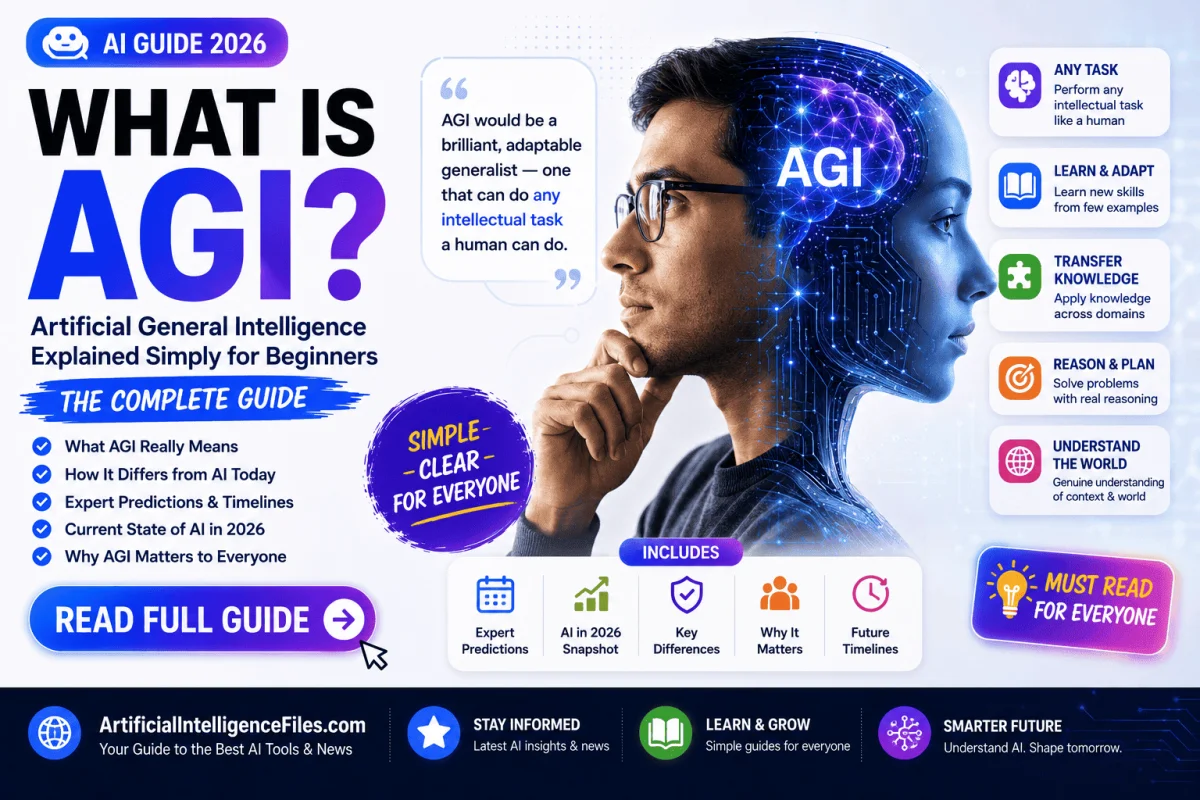
Artificial General Intelligence would be different in a fundamental way. An AGI system would be able to do any intellectual task that a human can do — not just one specific thing, but the full range. Reasoning, learning new skills from scratch, planning long-term goals, creative thinking, understanding context across completely different domains, solving problems it has never seen before.
The simplest way to understand AGI is this: today's AI is a collection of very talented specialists. AGI would be more like a brilliant, adaptable generalist — one that can switch between being a lawyer, a scientist, an engineer, a writer, and a strategist depending on what is needed, without needing to be retrained for each role.
What is the Difference Between AI and AGI?
This is the question most people ask first — and the answer is actually straightforward once you think of it the right way.
Current AI — even the most impressive versions in 2026 — works by recognising patterns in enormous amounts of data it was trained on. When you ask ChatGPT a question, it is not thinking the way a human thinks. It is finding the most statistically likely response based on everything it has ever processed. It is extraordinarily good at this — good enough to pass bar exams, medical licensing tests, and coding interviews. But it cannot learn a genuinely new skill from a single example the way a child can. It cannot reason through a problem it has truly never encountered. It does not understand the physical world it has never experienced.
AGI would cross these boundaries. It would learn new domains the way humans do — from observation, experimentation, and a small number of examples rather than billions of training examples. It would transfer knowledge from one area to help solve problems in a completely different area. It would have genuine reasoning ability — not just pattern matching that looks like reasoning, but the ability to work through problems from first principles.
No AI system in 2026 has definitively crossed this line. But the distance between current AI and AGI is getting smaller every year — faster than most people expected even two years ago.
Where Are We Now? The State of AI in 2026
Understanding where we stand today helps make the AGI debate much clearer.
The most capable AI systems in 2026 are what some researchers call "almost general" — systems that perform at or above human level on a remarkable range of cognitive tasks, but still have clear gaps when it comes to learning completely new skills, sustained planning over long time horizons, physical embodiment, and genuine understanding of the world.
Long-horizon autonomous agents — AI systems that can plan and execute complex, multi-step tasks in real-world professional settings — are already being deployed in law, medicine, software engineering, and corporate finance in 2026. These systems do things that would have seemed like science fiction five years ago. But they are still operating within narrow domains, not across the full spectrum of human cognitive ability.
The gap between "very impressive narrow AI" and "true AGI" is real — but the pace of closing that gap is exactly what has made this conversation so urgent.
When Will AGI Actually Arrive? What Experts Are Predicting in 2026
Here is where things get genuinely fascinating — and genuinely contested.
Nobody agrees. The honest answer to "when will AGI arrive" is that experts are divided by years or even decades. But understanding where those disagreements come from tells you a great deal about what AGI actually requires.
The optimistic view — lab CEOs and AI entrepreneurs generally predict the soonest timelines. Sam Altman of OpenAI has stated that the company knows how to build AGI and predicted AI agents would integrate deeply into the workforce very soon. Dario Amodei, Anthropic's CEO, has claimed AGI could arrive as early as 2026 or 2027 — and Anthropic's formal submission to the US Office of Science and Technology Policy echoes this as one of the more aggressive official predictions from any major lab. Demis Hassabis of Google DeepMind said AGI will "begin to happen in 2030."
The measured view — prediction markets and large surveys sit in the middle. Metaculus, a platform with a strong track record of accurate aggregate forecasts, puts the community median at a 25% chance of AGI by 2029 and 50% by 2033. A comprehensive synthesis of industry reports from 2025 placed a 50% probability on early AGI-like systems emerging between 2026 and 2028 — systems showing human-level reasoning in specific domains — but reserved "Full AGI" across all tasks for the 2030s at the earliest.
The sceptical view — many academic researchers push timelines significantly further out. A large-scale expert survey published in early 2026 put the median estimate for "high-level machine intelligence" at 2047 — more than two decades away. These researchers argue that current AI architectures have fundamental limitations that no amount of additional computing power will overcome. They point to hallucinations, reasoning failures on novel problems, the complete absence of embodied understanding, and the inability to learn genuinely new skills from minimal examples as evidence that today's AI is still far from AGI, regardless of how impressive it appears on tests designed by humans.
The honest summary: lab CEOs cluster their predictions around 2026 to 2028. Academic sceptics cluster around 2035 to never under current architectures. Prediction markets, which aggregate thousands of informed forecasters, currently sit around 2030 to 2035 for the median case.
Is AGI Dangerous? What Experts Actually Say
This is the question that matters most to most people — and it deserves an honest, balanced answer.
The concern about AGI safety is not science fiction. It is taken seriously by some of the world's most rigorous scientists and technologists — including many of the people actively building it.
The core concern is alignment — ensuring that an AGI system pursues goals that are genuinely beneficial to humans rather than goals that seem similar but diverge in dangerous ways when pursued by a system far more capable than any human. A system with human-level or superhuman intelligence pursuing a subtly wrong goal could cause enormous harm before humans could intervene or correct it.
Geoffrey Hinton, who won the 2024 Nobel Prize in Physics for his foundational work in AI, left Google specifically to speak openly about these risks. He has called AI safety "one of the most important problems in the world" and has expressed concern that the speed of development is outpacing the development of safeguards.
Anthropic, one of the leading frontier AI labs, was founded specifically because its founders were worried that AI development was proceeding too fast without adequate safety research. Their work focuses on making AI systems more transparent, more predictable, and more aligned with human values before reaching more powerful capabilities.
At the same time, many researchers argue that these risks, while real, are manageable and should not slow beneficial AI development. They point out that dangerous misalignment at AGI level is not inevitable — and that the benefits of AGI in medicine, climate science, education, and poverty reduction could be extraordinary if development goes well.
The honest position is that the risks are real and taken seriously by serious people, the potential benefits are also extraordinary, and the outcome depends heavily on how carefully and responsibly the development proceeds.
What Would AGI Actually Mean for the World?
It is worth spending a moment on what a world with AGI could look like — because the stakes in either direction are genuinely enormous.
On the positive side, AGI could compress decades of scientific progress into years. Diseases that have resisted treatment for centuries could be solved by a system that can simultaneously hold the entire body of medical knowledge, generate novel hypotheses, and design and evaluate experiments without human limitation. Climate solutions, educational personalisation at global scale, and economic productivity gains that could lift billions of people out of poverty are all on the table.
On the challenging side, the economic disruption from AGI would dwarf anything seen from previous technological revolutions. If a system can perform any intellectual task better than a human, the implications for employment, power distribution, and geopolitical balance are profound and genuinely unpredictable.
This is why AGI is not just a technology conversation. It is a conversation about what kind of world we want to build — and who gets to decide.
Final Thoughts
AGI is not science fiction and it is not imminent doom. It is a genuine technological goal being actively pursued by the world's most well-funded and talented research teams — and the debate about when it will arrive and how it should be developed is one of the most important conversations of our time.
Whether AGI arrives in 2028 or 2045, understanding what it is, what it would mean, and why the people building it are both excited and worried about it makes you a more informed citizen of the world it is being built in.
The best tools available today — ChatGPT, Claude, Google Gemini — are remarkable achievements that are already changing how people work and learn. AGI would be something qualitatively different. And preparing to understand it starts with conversations like this one.
Want to stay updated on the latest AI news, tools, and the biggest conversations happening in AI right now? Visit ArtificialIntelligenceFiles.com — your simple guide to everything happening in AI, updated every week.
Frequently Asked Questions (FAQs)
Q1. What is AGI in simple words?
AGI stands for Artificial General Intelligence. It refers to an AI system that can perform any intellectual task a human can do — not just one specific task, but the full range of human cognitive abilities including reasoning, learning new skills quickly, creative thinking, and problem-solving across completely different domains. Today's AI tools are "narrow AI" — brilliant at one thing but limited outside it. AGI would be a flexible, general-purpose intelligence more like a human mind than a specialised tool.
Q2. What is the difference between AI and AGI?
Current AI — including ChatGPT, Gemini, and Claude — is narrow AI. It performs specific tasks extremely well because it has been trained on enormous amounts of data related to those tasks. It cannot learn a genuinely new skill from a few examples, transfer knowledge effectively between very different domains, or reason through truly novel problems from first principles. AGI would do all of these things — functioning as a general intelligence capable of any cognitive task rather than a specialist optimised for one type of work.
Q3. When will AGI be achieved according to experts in 2026?
Expert predictions vary widely. The CEOs of OpenAI, Anthropic, and Google DeepMind predict AGI arriving somewhere between 2026 and 2030. Prediction markets like Metaculus put a 50% probability on AGI by 2033. Large-scale academic surveys put the median estimate closer to 2047. The honest answer is that nobody knows with certainty — and much of the disagreement comes from the fact that experts do not even fully agree on the precise definition of what would count as AGI.
Q4. Is AGI dangerous? What do experts say?
Many serious researchers — including Nobel Prize winner Geoffrey Hinton and the founders of Anthropic — believe AGI poses genuine risks that need to be taken seriously. The main concern is alignment — ensuring that an AGI system pursues goals that are genuinely good for humanity rather than goals that diverge in dangerous ways when pursued by a very powerful system. At the same time, many researchers believe these risks are manageable and that the potential benefits of AGI in medicine, science, and human wellbeing are extraordinary. The consensus is that the risks are real, the benefits are real, and the outcome depends on how carefully development proceeds.
Q5. Does AGI exist already in 2026?
No AI system in 2026 definitively qualifies as AGI by the most rigorous definitions. The most advanced systems — including the latest versions of ChatGPT, Claude, and Gemini — perform at or above human level on a remarkable range of tests and professional tasks. But they still cannot learn completely new skills from a handful of examples the way humans can, they struggle with genuinely novel problems that fall outside their training, and they have no understanding of the physical world they have never experienced. Some researchers argue that we are in an "almost general" phase — closer than ever before, but not yet there.